Simulation & Queueing · DES
Hospital Outpatient Clinic Simulation
A discrete-event model of appointments, walk-ins, doctors, X-ray rooms, priorities, queues, and time-dependent service.
- Python
- SimPy
- NumPy
- Matplotlib
PROJECT AT A GLANCE
From input to outcome
PROJECT OUTPUTS
Results and evidence
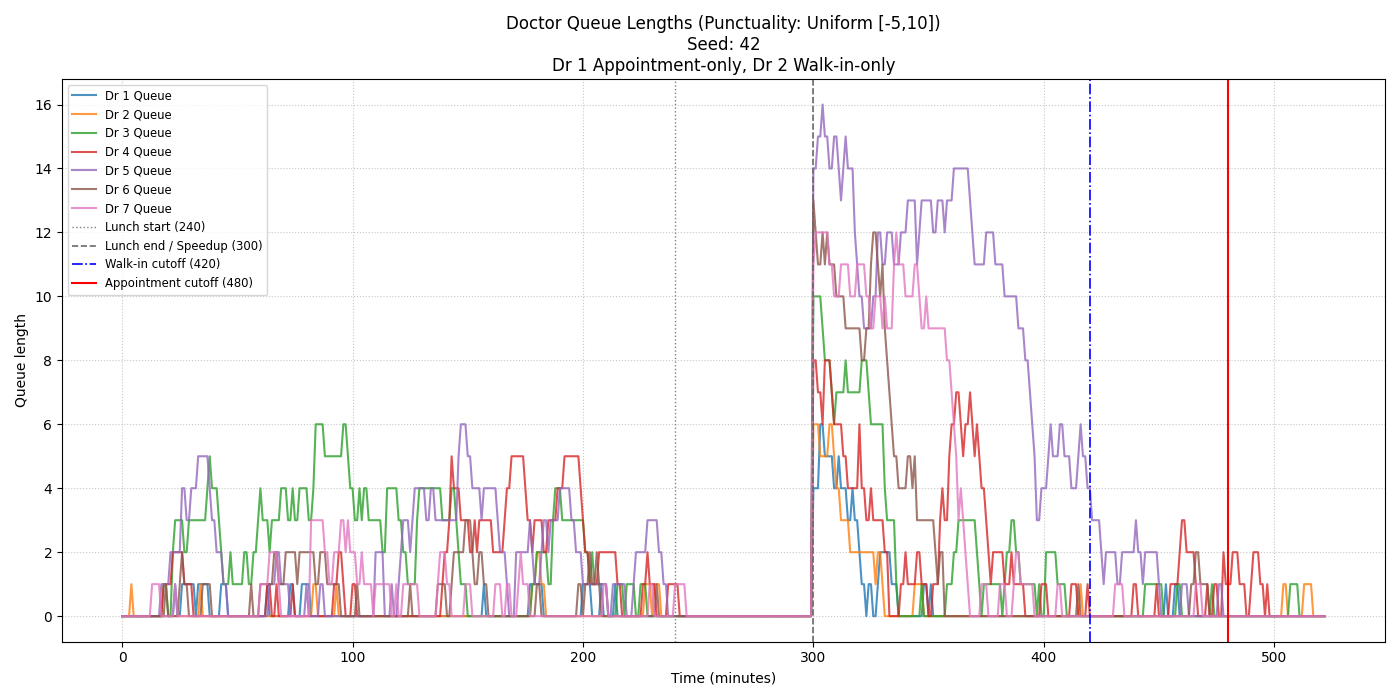
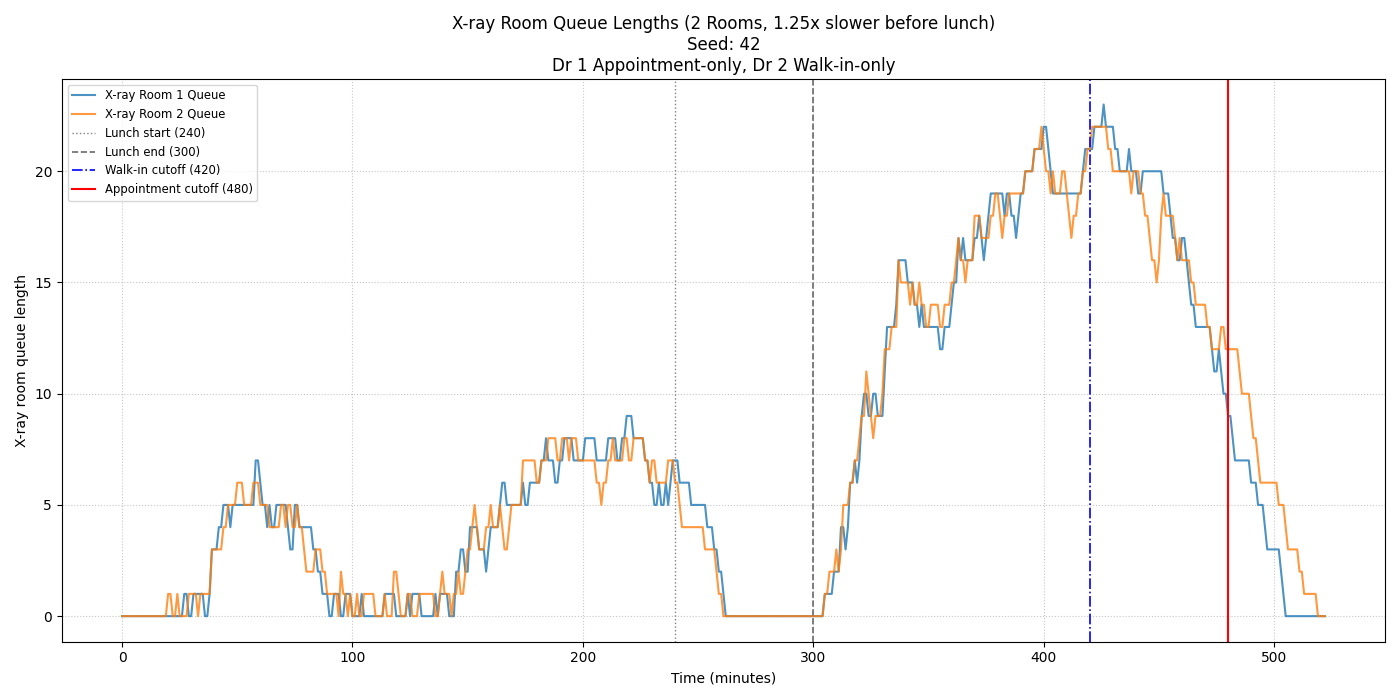
Project documentation
Hospital Outpatient Clinic Simulation (SimPy)
This repository contains a discrete-event simulation of an orthopedic outpatient department, implemented in Python using SimPy.
The model simulates patient flow through doctor examinations and X-ray services, incorporating appointments, walk-ins, lunch breaks, priority rules, and resource constraints to analyze queue lengths, waiting times, and resource utilization.
Problem Description
The outpatient clinic operates with:
- Multiple doctors
- Limited X-ray rooms
- A mix of appointment-based and walk-in patients
- Time-dependent behaviors such as lunch breaks and afternoon speed-up
Patients may require:
- First examination
- X-ray imaging
- Second examination (if X-ray is required)
The objective is to analyze how scheduling policies and resource allocation affect queues, waiting times, and throughput.
Modeling Approach
- Discrete-event simulation using SimPy
- Priority-based resource allocation
- Doctor-specific stochastic service-time distributions
- Appointment punctuality modeled via uniform deviation
- Time-dependent service speed (afternoon speed-up)
- Slower X-ray service before lunch end
Key Features
- Appointment and walk-in patient streams
- Priority handling for appointments vs. walk-ins
- Doctor lunch breaks with service suspension
- Second examination routing after X-ray
- Multiple X-ray rooms with queue balancing
- Detailed event logging
- Queue length tracking over time
- Performance statistics and visualizations
Supported Patient Types
- Appointment patients
- Walk-in patients
- Type A: requires X-ray
- Type B: no X-ray
Simulation Policies
- Priority rule:
- Appointments are prioritized using their scheduled time
- Walk-ins receive a large priority offset to ensure lower priority
- Special doctor roles (configurable):
- Appointment-only doctor
- Walk-in-only doctor
- Lunch break:
- Doctors pause service between predefined times
- Afternoon speed-up:
- Doctor service times are reduced after lunch
Repository Structure
hospital-outpatient-simulation/
├── main.py
├── outputs/
│ ├── doctor_queue_lengths.png
│ └── xray_queue_lengths.png
├── README.md
Requirements
- Python 3.x
- simpy
- numpy
- matplotlib
Install dependencies with:
pip install simpy numpy matplotlib
How to Run
Run the simulation with: python main.py
Simulation parameters (e.g., number of doctors, lunch times, priority rules) are defined at the top of main.py.
Output
The simulation produces:
Detailed event logs (arrival, service start/end, departure)
Queue length plots for:
- Doctors
- X-ray rooms
Summary statistics including:
Total patients served
Appointment vs. walk-in counts
Doctor workloads
X-ray utilization
Referral rates per doctor